Need help? Call Us Now :+91 98253 28286

Ventilation
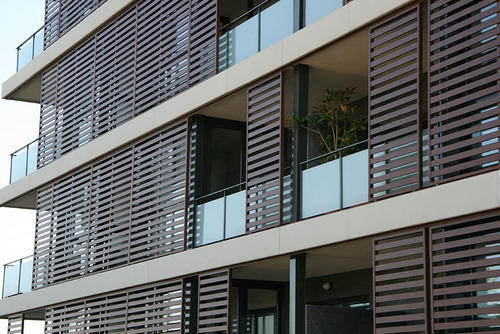
Louvre windows allow light and fresh air to enter the building. With the respective control unit, they may also serve as natural smoke and heat extractors or as supply air units in case of fire. But above all, they make a significant contribution to the overall visual impression of the building. SHREE louvre windows blend into the facade in such a way that they don’t interfere with the building as a whole but enhance it visually. Withal, we attach a particularly high importance to energy efficiency. Using these systems, the requirements of the current EnEV can be significantly undercut. Low joint pass through coefficients and U-values up to 0.5 W/m²K help saving energy
ADJUSTABLE VENTILATION
Energy consumption for heating, cooling, and ventilating buildings often accounts for the largest part of a country’s energy usage, which is still mainly based on fossil fuels. There is a great global emphasis on reducing the reliance of buildings on
fossil fuel energy and a move toward Nearly Zero Carbon Buildings (NZCB). This requires a major shift in the way buildings and their integrated heating, cooling, and ventilation systems are designed, operated,
and maintained. Achieving this goal will require a rethink of the traditional designs of and types of systems currently in use. The proportion of ventilation energy in comparison with the total energy use in
a building is expected to increase as the building fabric energy performance improves and ventilation standards recommend higher ventilation rates for improving indoor air quality (IAQ). At the same time, new
building regulations (Directive 2010/31/EC, 2010; Building Regulation, 2010) are imposing air-tight construction, which will inevitably impact on IAQ, health (e.g., sick building syndrome), and human productivity
in some future buildings.
FIX VENTILATION
The main purposes of a Heating, Ventilation and Air-Conditioning (HVAC) system are to help maintain good indoor air quality through adequate ventilation with filtration and provide thermal comfort. HVAC systems are among the largest energy consumers in
schools. The choice and design of the HVAC system can also affect many other high performance goals, including water consumption (water cooled air conditioning equipment) and acoustics.


We are dedicated to design with excellence and focus on quality.
Completely synergize resource taxing relationships via premier niche markets. Professionally cultivate one-to-one customer service with robust ideas. Dynamically innovate resource-leveling customer service for state of the art customer service.
Objectively innovate empowered manufactured products whereas parallel platforms. Holisticly predominate extensible testing procedures for reliable supply chains. Dramatically engage top-line web services.
Completely synergize resource taxing relationships via premier niche markets. Professionally cultivate one-to-one customer service with robust ideas. Dynamically innovate resource-leveling customer service for state of the art customer service.Objectively innovate empowered manufactured products whereas parallel platforms. Holisticly predominate.